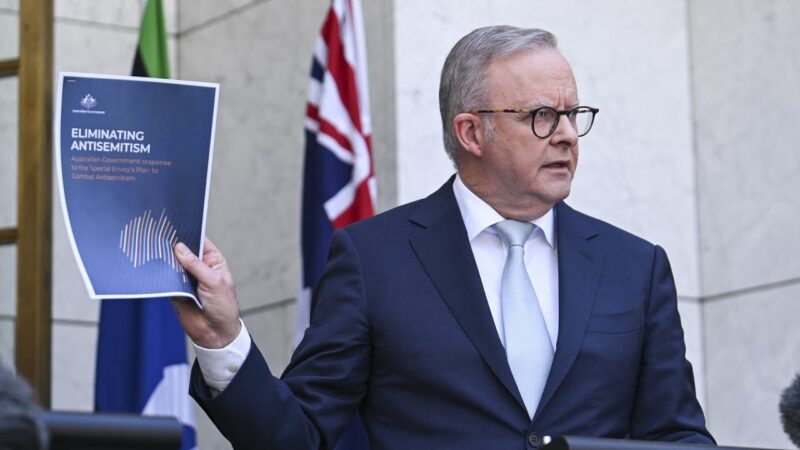
Anthony Albanese has announced the government “adopts and fully supports Jillian Segal’s plan to combat antisemitism,” bowing to intense media pressure. Stephanie Tran and Kim Wingerei report.
Criticising the state of Israel is about to get difficult.
Speaking at a press conference on Thursday, the Prime Minister said, “We’ve already legislated for hate speech, hate crimes, hate symbols, outlawing doxxing,” adding the government would implement all 13 recommendations “in consultation with the Jewish community and the envoy.” His words hint at a cop-out with a bit of wriggle-room.
The 13 recommendations he refers to are from Anti-Semitism Envoy Jillian Segal’s report, presented in July this year, including the adoption of the controversial definition of anti-semitism by the International Holocaust Remembrance Alliance – the “IHRA definition.”
Never intended to “chill speech”
The government’s formal response endorses the IHRA definition as Australia’s official definition by publishing a new “supplementary guide” by the Special Envoy to assist its application in an Australian context. Until that’s been published, it is unclear what this will mean in practice.
First adopted by Australia in 2021 under the Morrison government, the definition includes 11 illustrative examples, most of which relate to criticism of the State of Israel.
Kenneth Stern, the lead drafter of the IHRA definition, has cautioned against its use as a disciplinary tool. Stern has repeatedly said the definition was never intended to “target or chill speech”.
“Starting in 2010, right-wing Jewish groups took the “working definition”, which had some examples about Israel … and decided to weaponise it with title VI cases,” Stern wrote in a Guardian op-ed.
In 2021, the Jerusalem Declaration on Antisemitism was supported by hundreds of Jewish scholars in response to what they described as the IHRA definition’s “unclear” and “controversial” framing. The Declaration’s preamble states:
“The IHRA Definition includes 11 “examples” of antisemitism, 7 of which focus on the State of Israel. While this puts undue emphasis on one arena, there is a widely-felt need for clarity on the limits of legitimate political speech and action concerning Zionism, Israel, and Palestine.”
Burgatory ruling
In a recent Melbourne Magistrates’ Court ruling, a magistrate rejected police attempts to treat anti-Zionist chanting as a strict-liability offence, finding prosecutors must prove intent to insult or offend.
The court found that political speech must go beyond a mere difference of opinion and be “contrary to contemporary standards of public good order” to constitute a criminal offence.
Outside the court, Hash Teyeh hailed the ruling as “a huge win for the freedom of political speech”.
Manufactured antisemitism. Universities relied on fudged numbers
New immigration powers
The government’s response also includes expanded immigration powers, with the government “collaborating with the Special Envoy for Antisemitism to enhance training of immigration officers”.
Minister for Home Affairs Tony Burke said, “We will be changing the law to make visa cancellation and visa refusal easier. … I have refused and cancelled visas on the grounds of antisemitism in a way that very few predecessors have. I don’t resile from that.
And I’ve made clear on the balance of bigotry versus freedom of speech.
Antisemitism Education Taskforce
In response to Segal’s recommendation to “foster long-term societal resilience by ensuring throughout Australian society an understanding of, and familiarity with, the nature, history and danger of antisemitism,” the Government will establish “the Antisemitism Education Taskforce (the Taskforce) to be chaired by David Gonski AC,” the perennial go-to man for aspirational plans.
The aspirations are to encompass all levels of education, from kinder to uni, in a concerted effort to ensure “a deep understanding of Jewish Australians’ history and culture, and a mature understanding and expression of Australian values.”
The plan does not touch on what those values are, but there is the odd, cursory nod to combating racism in general, including funding for an SBS podcast “to dispel misinformation and disinformation impacting Australia’s social cohesion.”
Security, law enforcement and coordination
A new AFP special taskforce is to be established, “to investigate threats, violence and hatred towards the Australian Jewish community and parliamentarians.”
The government has also committed $159.5m in security funding to the Executive Council of Australia Jewry and other community groups, “to improve safety and security at Jewish community sites, including synagogues, and to protect Jewish students in schools and higher education.”
Recommendations not adopted
Some of the more controversial proposals in Segal’s original report were omitted from the government’s formal response, albeit not explicitly rejected.
These include recommendations to allow public funding to be terminated for cultural institutions or festivals deemed to have failed to address antisemitism, or the removal of charity tax status for “problematic organisations.”
See below for a detailed analysis of what has been included and what has not. Only 31% of the original recommendations are to be implemented “as is.”